I do not claim to be a farmer, and I am certainly not a survivalist. But I have spent a lifetime paying attention to things most people overlook: motors, machines, systems, and nature. And one thing I have noticed for decades is this: Many of the most nutritious foods on Earth grow like weeds… and most folks pull them out and throw them away.
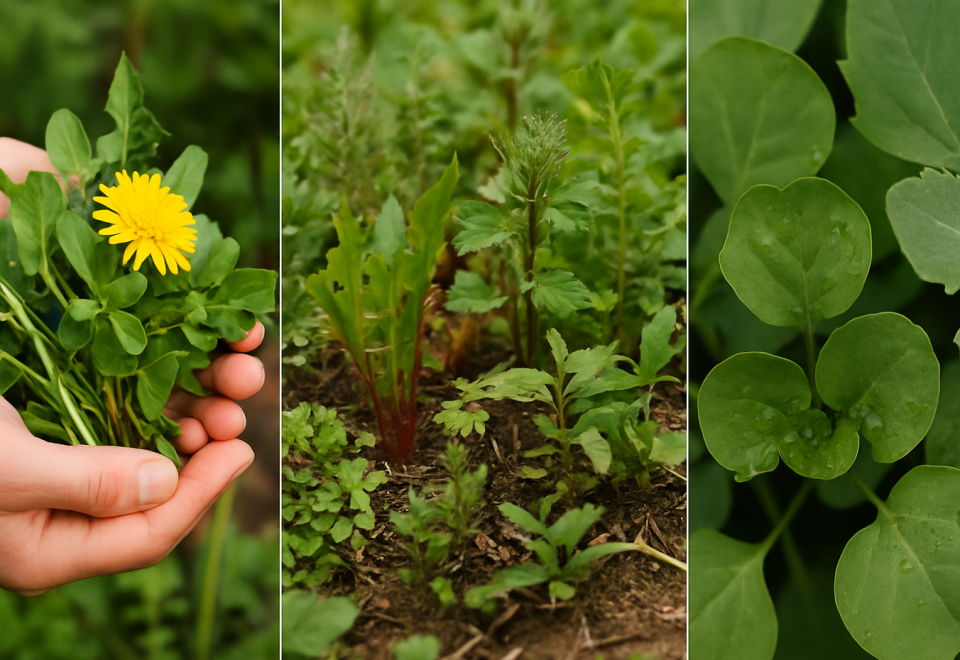
Some people have told me they spend good money on supplements, powders, and pills to get nutrients that are literally growing between the cracks in their driveway. Others spray poison on them. That always struck me as backwards.
What follows is not theory. These are plants that grow easily, often year-round, require little care, and in many cases outperform store-bought vegetables nutritionally. Some have kept humans alive through famines and hard times. And many are surprisingly tasty once you stop thinking of them as “weeds.”
A Simple Truth About Food Security
Highly complex systems tend to fail under stress. Simple systems endure. Nature already solved the food problem. We complicated it.
If a plant:
-
- grows without help
- survives poor soil
- resists pests
- reseeds itself
- and comes back year after year
there is probably a reason.
Here are 20 vegetables and edible plants that many folks already have growing nearby, whether they know it or not.
20 Edible “Weeds” That Could Sustain Human Life
1. Dandelion
Leaves, roots, and flowers are all edible. High in vitamins A, C, K, calcium, and iron. Bitter in salads, excellent cooked.
2. Lamb’s Quarters (Wild Spinach)
Often weeded out of gardens. More nutritious than spinach. Mild flavor when cooked.
3 Purslane
One of the highest plant sources of omega-3 fatty acids. Crisp, slightly lemony. Grows in cracks and dry soil.
4. Chickweed
Tender, mild, and good raw or cooked. Rich in minerals and vitamin C.
5. Plantain (Broadleaf or Narrowleaf)
Not the banana. Leaves are edible when young. Seeds are high in fiber.
6. Wild Amaranth (Pigweed)
Leaves and seeds are both food. Seeds are protein-rich and gluten-free.
7. Mallow
Soft leaves and immature seed pods are edible. Mild and soothing to digestion.
8. Nettles
Cooked, not raw. Extremely nutritious. High in iron and protein.
9. Curly Dock
Young leaves cooked like greens. Seeds can be ground into flour.
10. Sorrel
Tangy, lemon-like flavor. High in vitamin C. Good in soups.
11. Miner’s Lettuce
Grows in cool seasons. Tender and mild. Named because it prevented scurvy.
12. Garlic Mustard
Invasive but edible. Peppery greens, garlicky root.
13. Wild Mustard Greens
Spicy leaves, edible flowers, nutritious seeds.
14. Clover
Leaves and flowers edible. Can be cooked or dried for tea.
15. Shepherd’s Purse
Young leaves are edible. Seeds are used like pepper.
16. Bittercress
Peppery taste. Often grows in winter and early spring.
17. Wild Onion / Wild Garlic
Easy to identify by smell. Flavorful and medicinal.
18. Burdock
Roots are a staple food in Asia. Leaves and stalks also edible.
19. Watercress
Grows near clean water. One of the most nutrient-dense greens known.
20. Purslane Sea Variety (Coastal Regions)
Salt-tolerant, mineral-rich, and self-seeding.
Why These Plants Matter
Many folks have told me they worry about:
-
- food prices
- supply chains
- chemical residues
- and declining nutritional quality
These plants address all of that quietly.
They:
-
- require no fertilizer
- require no tilling
- require no seed catalogs
- grow without permission
And they keep showing up whether we want them or not. That should tell us something.
Once you start paying attention to the so-called “weeds,” you realize something else pretty quickly. There are also vegetables that have sustained civilizations for thousands of years that you plant once, need no cultivation, irrigation, or special care — and don’t play well in industrial farming.
Some of the most valuable food plants were not weeded out by accident.
They were forgotten.
Many of these plants fed people long before modern agriculture, grocery stores, and shipping trucks. They grow quietly, often underground, or in places people no longer look. A few of them were staple foods for Native American cultures, early settlers, and rural communities who understood local food systems.
Here are some uncommon but remarkable vegetables that deserve another look.
Uncommon Vegetables That Grow Easily and Sustain Life
1. American Groundnut (Apios americana)
This one deserves top billing.
It is a native North American vine that produces edible underground tubers, similar to potatoes, but higher in protein. Indigenous tribes relied on it heavily. It grows in poor soil, fixes nitrogen, and comes back year after year.
Once established, it feeds you quietly.
Flavor is nutty, rich, and satisfying.
2. Jerusalem Artichoke (Sunchoke)
Not from Jerusalem. Not an artichoke.
It is a sunflower relative that produces knobby tubers underground. Very productive, drought-resistant, and nearly impossible to kill. High in inulin fiber and good for gut health.
Some people have told me one plant can feed a family.
3. Skirret
An old European root vegetable once prized before potatoes took over. Sweet, crisp roots that grow in clusters. Hardy, perennial, and cold-tolerant.
A forgotten garden workhorse.
4. Sea Kale
Thrives in coastal or sandy soil. Leaves, shoots, and flowers are all edible. Once planted, it requires little attention and produces for years.
Very nutrient-dense.
5. Good King Henry
Often mistaken for a weed. Leaves used like spinach, shoots like asparagus, seeds like quinoa. Grows well in poor soil and cold climates.
A true multi-use food plant.
6. Yacon
A perennial root vegetable with crisp, sweet tubers. Grows large yields with little effort. High water content and prebiotic fiber.
Surprisingly refreshing.
7. Chinese Yam (Cinnamon Vine)
A climbing vine with underground tubers and edible aerial bulbils. Cold-hardy, perennial, and productive.
Low maintenance, high return.
8. Mashua
An Andean tuber that resists pests naturally. Leaves, flowers, and roots are edible. Hardy and prolific.
Another example of plants that solve problems on their own.
9. Oca
A colorful tuber related to wood sorrel. Easy to grow, nutritious, and stores well.
Often overlooked because it doesn’t look familiar.
10. Chufa (Tiger Nut)
Not a nut. A small tuber used since ancient Egypt. Can be eaten raw, roasted, or made into milk. Extremely resilient and nutrient-dense.
Why These Foods Disappeared
In my experience, systems tend to favor what is:
-
- easy to transport
- easy to standardize
- easy to patent
Not necessarily what is best for human health.
These plants don’t fit neatly into industrial systems. They don’t need chemical inputs. They don’t require centralized control. And they don’t generate repeat sales in the usual way.
So they quietly fell out of favor.
I am not suggesting anyone rip up their lawn tomorrow.
I am suggesting that real food often looks unfamiliar because we were never taught to recognize it.
Once you learn these plants:
-
- they feed you quietly
- they reduce dependence
- they grow while you’re busy living
And they remind us that survival does not always come from complexity. Sometimes it grows underground.
Some people say, “I tried that once. I didn’t like it.” That is normal. Taste adapts. The body recognizes real nutrition quickly. What starts as “bitter” often becomes “satisfying” once the body understands what it is getting.
Cooking methods matter too:
-
- sautéing
- steaming
- soups
- mixing with familiar foods
A little olive oil, garlic, and patience goes a long way.
I am not suggesting anyone abandon grocery stores or modern farming.
I am suggesting we stop poisoning, pulling, and ignoring some of the most resilient food sources we have.
Nature already planted them. They already grow. They already feed.
Sometimes the smartest solution is the one we’ve been stepping on.
~ Herb Roi Richards
Nutritional Comparison: Wild & Uncommon Plants vs. Common Vegetables
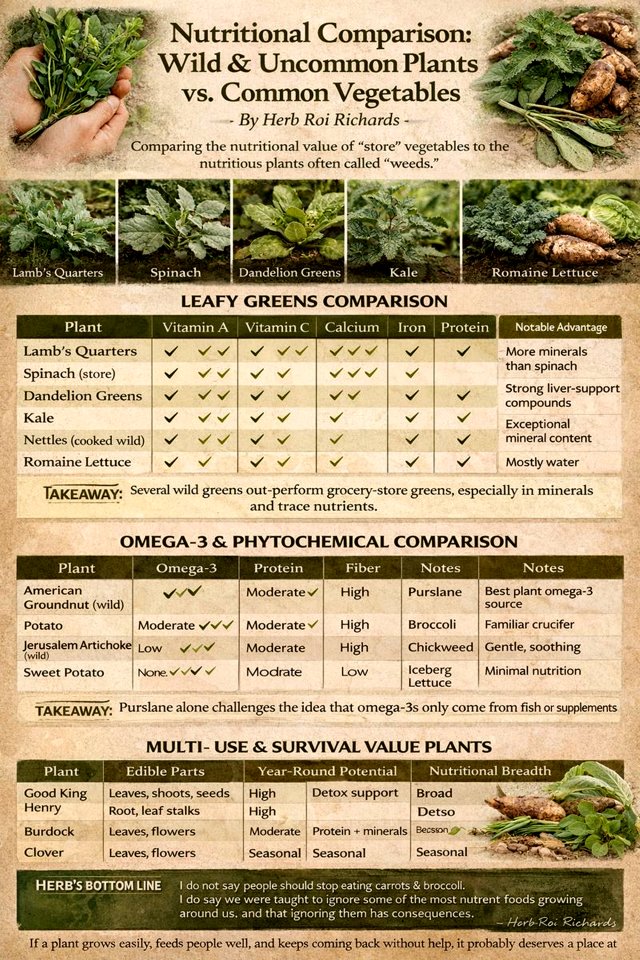
For those of you who have trouble believing that these weeds and uncommon veggies have any nutritional value, here is something to review:
Key Nutrients Compared
- Vitamin Density (A, C, K)
- Minerals (Calcium, Iron, Magnesium)
- Protein
- Special Benefits (Omega-3s, fiber, phytochemicals)
Leafy Greens Comparison
| Plant | Vitamin A | Vitamin C | Calcium | Iron | Protein | Notable Advantage |
| Lamb’s Quarters (wild) | Very High | High | High | High | Moderate | More minerals than spinach |
| Spinach (store) | High | Moderate | Moderate | Moderate | Moderate | Familiar, mild taste |
| Dandelion Greens | Very High | High | Very High | High | Moderate | Strong liver-support compounds |
| Kale | Very High | High | High | Moderate | Moderate | Widely accepted |
| Nettles (cooked) | Very High | High | Very High | Very High | High | Exceptional mineral content |
| Romaine Lettuce | Low | Low | Low | Low | Low | Mostly water |
Several wild greens outperform grocery-store greens, especially in minerals and trace nutrients.
Omega-3 & Phytochemical Comparison
| Plant | Omega-3 | Antioxidants | Fiber | Notes |
| Purslane | Extremely High | High | Moderate | Best plant omega-3 source |
| Broccoli | Low | High | High | Familiar crucifer |
| Chickweed | Low | Moderate | Moderate | Gentle, soothing |
| Iceberg Lettuce | None | Very Low | Low | Minimal nutrition |
Purslane alone challenges the idea that omega-3s only come from fish or supplements.
Root & Tuber Comparison
| Plant | Calories | Protein | Fiber | Special Value |
| American Groundnut | Moderate | High | High | More protein than potatoes |
| Potato | Moderate | Low | Moderate | Familiar staple |
| Jerusalem Artichoke | Low–Moderate | Low | Very High | Excellent gut prebiotic |
| Sweet Potato | Moderate | Low | Moderate | Beta-carotene |
The American groundnut is nutritionally closer to beans than potatoes, which explains why it sustained populations historically.
Multi-Use & Survival Value Plants
| Plant | Edible Parts | Year-Round Potential | Nutritional Breadth |
| Good King Henry | Leaves, shoots, seeds | High | Broad |
| Burdock | Root, leaf stalks | High | Detox support |
| Clover | Leaves, flowers | Moderate | Protein + minerals |
| Green Beans | Pods only | Seasonal | Moderate |
Now you get the idea that many of these “forgotten” plants offer multiple edible parts, increasing food security.
So, the question is: “Are these plants “as good” as normal Vegetables?”
From a nutritional standpoint:
✔ Many are equal
✔ Several are superior
✔ Most are more mineral-dense
✔ Nearly all are less processed and fresher
The main difference is familiarity, not value.
Modern vegetables were selected for:
-
- shelf life
- appearance
- shipping durability
Wild and uncommon plants were selected by survival. I do not say people should stop eating carrots and broccoli. You might catch me saying that we were taught to ignore some of the most nutrient-dense foods growing around us, and that ignoring them has consequences.
If a plant grows easily, feeds people well, and keeps coming back without help, it probably deserves a place at the table.
~ Herb Roi Richards