I have talked to a lot of people over the years who say the same thing: “I tried supplements. They didn’t work.” When I hear that, I don’t argue. I don’t doubt their experience. But I do wonder what they actually took. Because here’s something many folks don’t realize until much later: the label on the bottle tells you very little about what’s really inside. Source matters. Potency matters. And what something is derived from matters more than most people have been taught to ask.

“Natural” Doesn’t Always Mean What You Think It Means
You never really know what you’re getting. You go out of your way to visit a health food store. You read the label. You pay more than you would at the grocery store. You think you’re doing the right thing.
But let’s take something simple: cayenne pepper. I pay real money for mine. About $50 a pound, sourced from organic American farmers I know personally. People who care about the soil, the water, and the end product that goes into their neighbors’ bodies.
Large nutritional supply houses, on the other hand, can buy cayenne for about 50 cents a pound from overseas. Now ask yourself: How is that possible?
Many folks have told me that in some regions overseas, human waste is used as fertilizer, sometimes containing E. coli and other contaminants. Add in unregulated pesticides and insecticides, and you begin to see the problem.
When these so-called “natural ingredients” reach American shores, they are often fumigated with ethylene oxide gas so regulators can declare them “safe.” What most people are not told is that this gas can remain active on plant material for months. Some sources associate long-term exposure with serious health concerns. So yes, it may pass inspection. But passing inspection does not mean it nourishes your body.
Why Supplements “Don’t Work” for Many People
In my experience, when people don’t see results, there are usually two main reasons:
- The Source Is Poor
-
- Petrochemical derivatives
- Industrial byproducts
- Heavily processed plant material
- Offshore sourcing with minimal oversight
A supplement can technically contain the right name of an ingredient while offering very little real biological value.
- The Potency Is Watered Down
Many over-the-counter supplements contain:
-
- Just enough of an ingredient to list it on the label
- Large amounts of fillers
- Binders and flow agents
In the best case, those fillers are inert. In the worst case, they interfere with absorption or create an additional burden for the body.
A Few Examples People Should Look At More Carefully
Vitamin B-12
Most people know B-12 is important. What they don’t know is where it often comes from.
Commercial B-12 is inexpensively extracted from sewage sludge. Yes, human waste. Others are derived from animal sources that may carry residues of:
-
- antibiotics
- growth hormones
- prescription drugs
- pesticides
All of these sources can still be labeled “natural” or “organic.”
Words on labels are flexible. Biology is not.
Estrogen-Related Supplements
For women, this is especially important.
Many folks have been told that “natural estrogen” is safer. What is often left out is that medical estrogen products are sourced from pregnant horse urine.
Rather than supplementing estrogen directly, many people have told me they prefer supporting the body’s own natural hormone production using plant-based and nutritional support strategies.
That distinction matters.
A Simple Rule of Thumb
If you tried something and it didn’t help, it does not automatically mean:
-
- the nutrient is useless
- your body doesn’t respond
- or “supplements don’t work”
It may simply mean you never actually got what you thought you were taking.
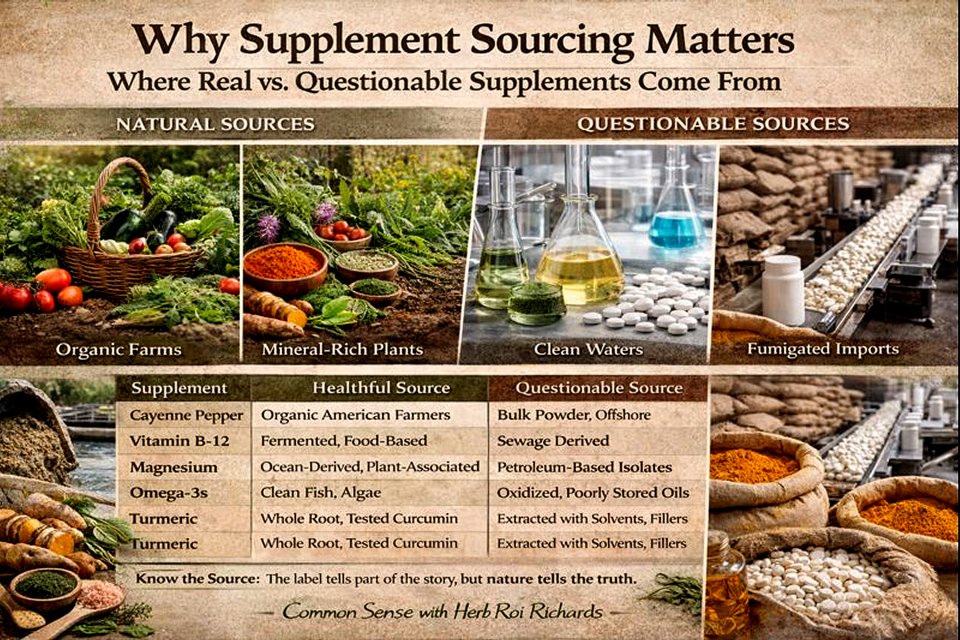
Supplement Sources: Healthful vs. Questionable
| Supplement | Healthful Source | Questionable Source |
| Cayenne Pepper | Organic, domestic, food-grade, known farmers | Offshore bulk powder, fumigated, unknown soil |
| Vitamin B-12 | Fermentation-based, food-derived | Sewage-derived, industrial extraction |
| Magnesium | Ocean-derived, plant-associated | Petroleum-based isolates |
| Vitamin C | Acerola cherry, camu camu | Synthetic ascorbic acid from corn syrup |
| Turmeric | Whole-root, tested curcumin profile | Extracts with solvents and fillers |
| Estrogen Support | Herbs supporting natural production | Direct hormone supplementation |
| Iodine | Mineral-balanced natural sources | Industrial chemical iodine |
| Iron | Plant-based chelates | Metallic iron filings |
| Omega-3s | Clean fish or algae | Oxidized oils, poorly stored capsules |
| Probiotics | Live, strain-verified cultures | Shelf-stable fillers with low viability |
A General Caveat Worth Remembering
I am not telling anyone what to take or what not to take.
I am saying this: If you are going to invest in your health, invest in understanding what you are actually putting into your body.
Cheap inputs rarely produce strong results.
When something is grown with care, appropriately harvested, handled gently, and delivered fresh, the body tends to recognize it. That has been my observation.
People are not failing supplements. Supplements are failing people. And in many cases, the failure starts long before the bottle ever reaches the shelf.
If you don’t know the source, you don’t really know the supplement.
~ Herb Roi Richards