If you want to watch an idea travel from miracle… to ordinary… to feared… and then quietly make a comeback, take a look at iodine. This little purple-black mineral has had one of the strangest journeys in modern health history. For a long time, iodine was not considered unusual. It was common. Doctors used it. Families kept it in the cupboard. Sailors depended on it without even knowing they were doing it.
Then somewhere along the way, attitudes changed. The public memory changed. And before long, people started looking at iodine like it was some dangerous fringe substance instead of something that had once been considered essential. That doesn’t mean every old use was right. But it does raise an interesting question:
How did we get from “every household has iodine” to “why would anyone take iodine?” Let’s take a walk through history.
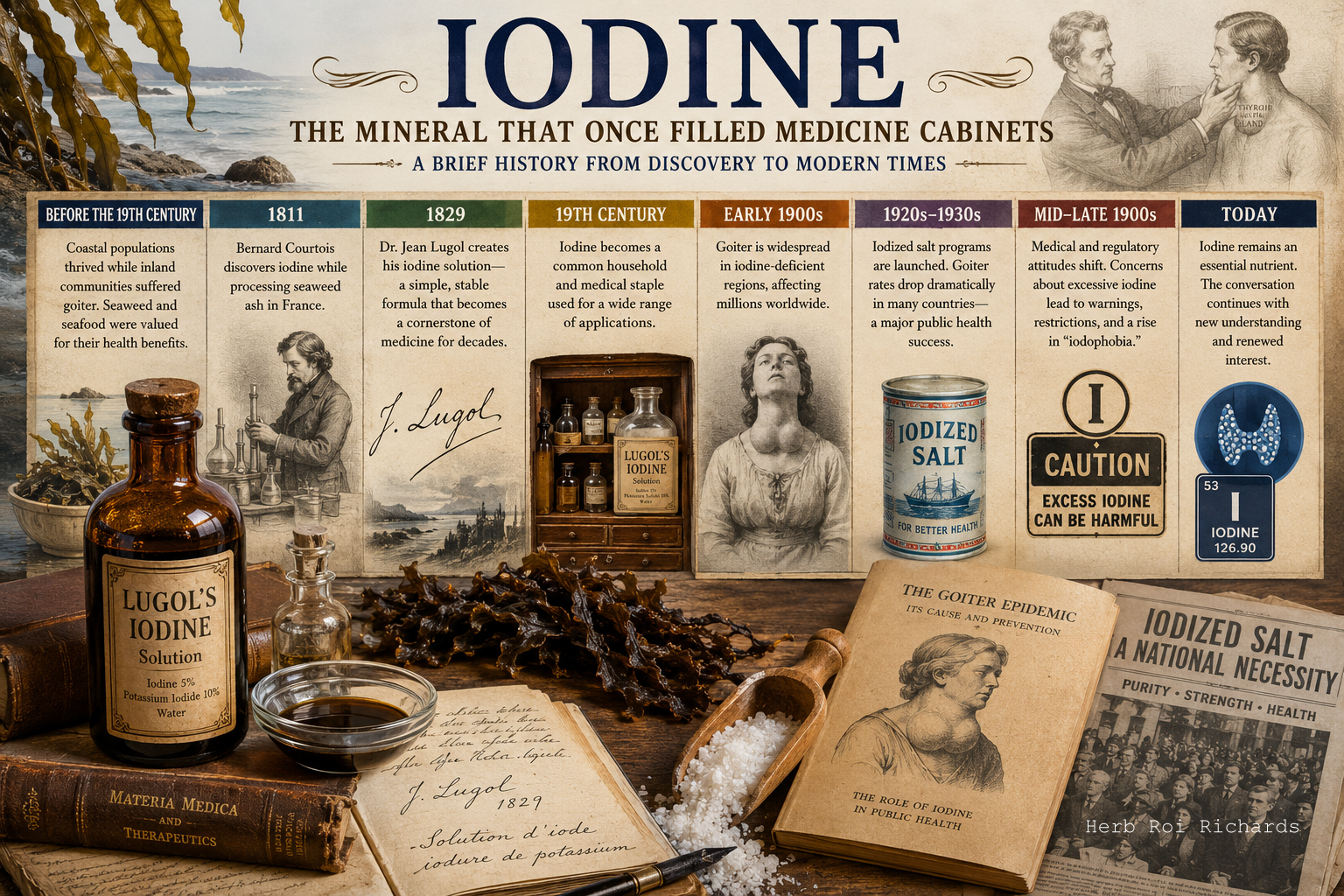
Before the 20th Century: Iodine Was Big News
People understood iodine long before they knew what iodine actually was.
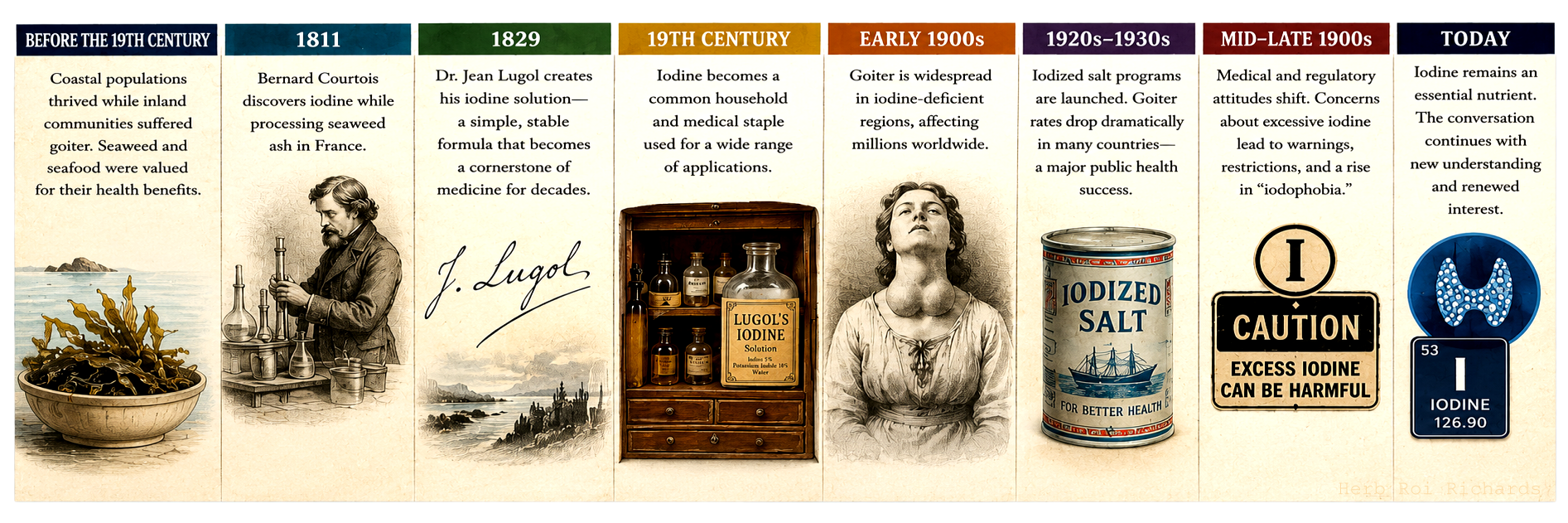
For centuries, coastal populations seemed to avoid the swollen neck condition we now call goiter more often than inland populations. Nobody knew the chemistry. They simply noticed that people living near the sea seemed to have something others didn’t. Seaweed, seafood, and ocean air all became associated with better outcomes.
Then, in 1811, a French chemist named Bernard Courtois accidentally discovered iodine while processing seaweed ash. That changed everything.
By the 1800s, physicians began experimenting with iodine preparations for all kinds of conditions of the day. Some of those ideas held up. Others did not. But iodine quickly earned a reputation as one of medicine’s versatile tools.
Back then, medicine looked very different from what it does now. Doctors had fewer specialized drugs. So substances that appeared broadly useful often became widely adopted.
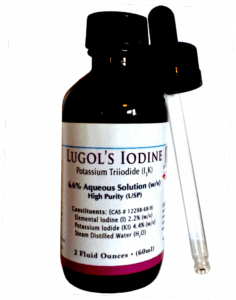
Enter Lugol’s Iodine: One Formula That Refused to Disappear
In 1829, French physician Jean Lugol introduced a preparation that would become legendary:
Lugol’s iodine.
His solution combined elemental iodine with potassium iodide dissolved in water. Simple. Stable. Portable. Easy to make.
Lugol originally believed his formula might support people dealing with diseases common in that era. Many of those hopes didn’t survive later scientific testing, but Lugol’s formula endured.
Why? Because iodine itself remained useful.
For generations afterward, Lugol’s iodine appeared in medical offices, hospitals, household cabinets, military kits, and emergency supplies.
If you talk to enough old ranchers, homesteaders, nurses, or people raised before the middle of the last century, you’ll hear stories. “Everything had iodine in it.” That may be an exaggeration. But not by much.
The Goiter Epidemic and the Birth of Iodized Salt
By the early 1900s, parts of North America and Europe faced a major problem. Large regions had iodine-poor soil. When soil lacks iodine, crops contain less iodine. When diets lack iodine long enough, thyroid problems, including goiter, become more common.
Entire communities developed visible thyroid enlargement. This became especially noticeable in inland regions. Public health researchers eventually proposed something surprisingly simple: Add tiny amounts of iodine to table salt.
Beginning in the 1920s, iodized salt programs spread and became one of public health’s most frequently cited nutrition interventions. Goiter rates declined dramatically in many regions.
That success story shaped how future generations thought about iodine. Instead of seeing iodine as something broadly discussed, public messaging narrowed: “Don’t worry about iodine. You already get enough from salt.” And for decades, that message largely stuck.
The Great Shift: From Household Staple to Controlled Use
Something interesting happened during the 20th century. Medicine became increasingly specialized. Instead of broad nutritional tools, the focus shifted toward diagnosis, precision dosing, pharmaceuticals, and targeted therapies.
At the same time, regulators began paying closer attention to substances that could affect hormone systems, including thyroid activity. And iodine absolutely can affect the thyroid.
Too little can be a problem. Too much can also be a problem. That reality changed the conversation.
Older generations remembered iodine as ordinary. Newer generations increasingly encountered warnings.
Over time, iodine moved from:
- household medicine cabinet
- general wellness discussions
- broad historical use
…into a narrower category requiring more caution and context.
That shift wasn’t necessarily irrational. But it changed public perception.
The Rise of “Iodophobia”
Some people use the term iodophobia to describe what they see as an exaggerated fear of iodine.
Researchers identified that excessive iodine intake can create problems in susceptible individuals. Medical organizations became more careful. Supplement labeling tightened. Public guidance became more conservative. But critics argue something else happened too:
The public stopped distinguishing between:
- appropriate intake
- supplemental intake
- excessive intake
Everything started getting lumped together.
For some people, iodine became viewed less as a nutrient and more as a chemical to avoid. And once public perception swings hard enough, history gets forgotten.
People forget there was a time when iodine bottles sat right next to aspirin.
Restrictions, Warnings, and Changing Formulas
Over time, several historical iodine preparations became less common. Some products disappeared. Others moved behind professional guidance. Manufacturing standards changed. Concentrations changed. Labeling changed. Many products that once existed in ordinary commerce became less visible.
At the same time, dietary patterns shifted. People consumed less iodized table salt. Processed food manufacturers didn’t always use iodized salt. Bread-making practices changed. Food systems evolved.
Ironically, while public concern about iodine sometimes increased, some experts began asking whether certain groups might actually consume less iodine than expected.
History has a sense of humor that way.
The Aftermath: Iodine Never Really Left
Today, iodine is still important. It remains recognized as an essential nutrient. It still supports normal thyroid hormone production. It still appears in nutrition guidelines.
Lugol’s iodine still exists. Sea vegetables still exist. Iodized salt still exists.
But the conversation became more nuanced than it once was. Maybe that’s progress. Maybe some of the old enthusiasm needed correction. Maybe some historical memory deserves revisiting too.
Either way, iodine’s story reminds us of something important:
Health history is rarely a straight line. Sometimes something goes from common… to forgotten… to rediscovered. And sometimes the most interesting question isn’t whether our grandparents were completely right. It’s whether they knew something worth remembering.
That doesn’t mean copying the past blindly. But it might mean staying curious enough to look back before deciding what belongs ahead.