I still like to ride motorcycles. I still enjoy a good four-wheeler ride. I still climb into heavy equipment on the ranch. I still spend time in the shop thinking up inventions that probably should not work, but sometimes do. I still write books. I still answer questions and help people think through their options. And for all of that, I need one thing that becomes more precious every year: My eyesight.
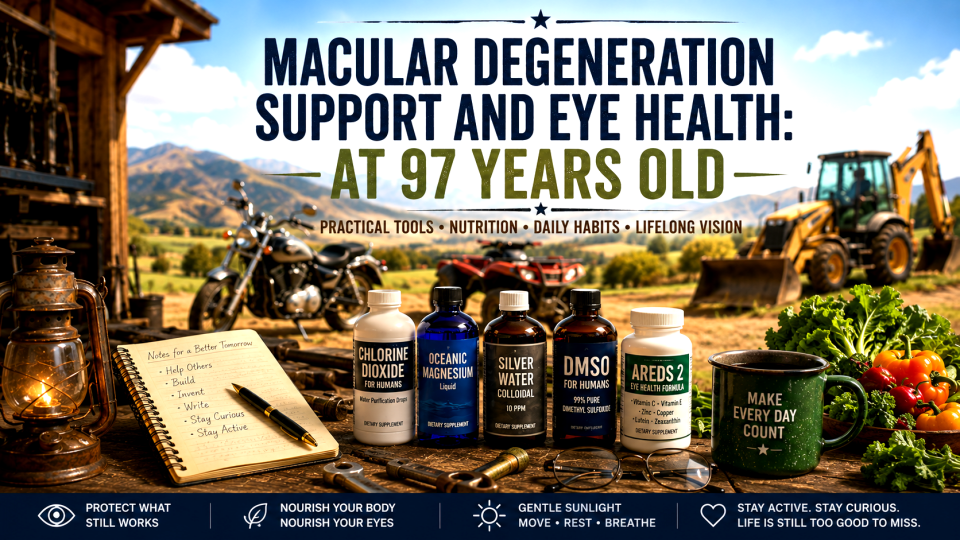
One of the things people start hearing about as they get older is age-related macular degeneration, often called AMD. The macula is the center part of the retina, the part that helps us see details, read, recognize faces, and focus on fine work. If that area starts losing function, people may notice blurry central vision, faded color, trouble reading, or missing spots in what they see.
If you enjoy building, driving, reading, gardening, painting, sewing, or watching grandkids grow up, you understand why people pay attention to preserving eyesight.
First Things First: Protect What Still Works
My philosophy has always been simple: If something is wearing out, do what you reasonably can to slow the wear. That does not mean panic. That does not mean chase every miracle. It means support the body and reduce unnecessary stress.
One of the most widely discussed nutrition approaches for macular degeneration comes from research supported by the National Eye Institute1. It is often called the AREDS2 formulation.
That approach includes:
- Vitamin C — 500 mg
- Vitamin E — 400 IU
- Zinc — 80 mg
- Copper (cupric oxide) — 2 mg
- Lutein — 10 mg
- Zeaxanthin — 2 mg
This combination has been studied for helping reduce progression risk in certain people with intermediate or advanced forms of AMD. It is not a cure. It does not restore lost vision. But it is one of the more established nutrition approaches people often discuss with their eye professionals.
That deserves respect. Also, note that you cannot get these amounts of supplementation through natural food sources.
My General “Eye Vitality” Way of Thinking
Over the years, I have written about different wellness tools in different books. Some of those ideas come from published research. Some come from historical use. Some come from conversations with people. Some come from observations.
I do not claim that all of these reverse macular degeneration. I simply think about whether they may support the conditions that healthy tissues prefer.
- Gentle Oxidative Balance
People who talk about aging eyes often talk about oxidative stress. In my writing, I have discussed chlorine dioxide in the broader context of reducing biological burden and creating cleaner internal conditions. Regarding macular degeneration, “Chlorine dioxide assists by oxidizing residue and improving microcirculation in retinal tissues… helps to protect nerve cells and slow degeneration,” from my book, Chlorine Dioxide for Humans2.
I’m not saying this is an established treatment for macular degeneration. But some people explore whether improving overall wellness and reducing sources of stress in the body may indirectly support tissues, including delicate nerve tissues.
- Magnesium and Relaxation of the System
I have written in my book, Oceanic Magnesium3, about macular degeneration, because magnesium shows up in hundreds of body processes.
Oceanic magnesium has been studied in relation to blood vessel tone, muscle relaxation, nerve signaling, and overall metabolic support.
Since the retina is a high-energy tissue that depends on circulation and cellular communication, some people become interested in whether maintaining healthy magnesium status supports long-term eye function. Again, not a cure. Just one piece of keeping the machine tuned.
- Silver Discussions
In my work with Wayne Rowland, silver came up often. Historically, silver has been used for antimicrobial and preservative purposes. Especially Wayne Rowland’s Tesla/Rife Silver Water. People sometimes extend those ideas much further than the evidence supports, based on actual results.
| Why Wayne Rowland Silver Water? Because of factory processes, results are always similar. |
I don’t know if I wholeheartedly agree with Wayne that his “Silver Water repairs eyes.”4 But there is little doubt that healthy tissues do better in cleaner, calmer environments.
- Tissue Support and Permeability Ideas
DMSO has fascinated people for decades because of how easily it moves through tissues. That interest has led many people to experiment with it in different contexts. But the eyes are one of the most sensitive tissues in the body.
In my book, DMSO for Humans5, I detail how to make DMSO eye drops. And my personal philosophy today is simpler than people expect: Protect the eyes. Avoid irritation. Respect sterility. Be careful.
Sometimes preserving function is the bigger victory.
Companion Products
Notable companion products include vitamin C, glutathione, bayberry, or goldenseal5 and aloe vera gel, apple cider vinegar, flaxseed oil, Lugol’s iodine, and Epsom salt2.
Companion Practices I Think Make More Sense Than People Expect
When I step back from all the excitement, I find myself returning to ordinary things.
Carotenoid-rich foods
People often talk about colorful foods because pigments like lutein and zeaxanthin naturally accumulate in the eye.
Think:
-
- leafy greens
- orange vegetables
- yellow vegetables
- colorful produce
Healthy fats
Many people discuss:
-
- flaxseed oil
- fish oils
- whole-food fats
because the retina contains a great deal of fat.
Gentle outdoor light
Not sunburn.
Not staring at the sun.
Just natural daylight and time outside.
General circulation support
-
- Movement
- Hydration
- Breathing
- Walking
Recovery habits
-
- Good sleep
- Less eye strain
- Regular breaks
My Personal Thought at 97
People ask me what I would do if I wanted to keep my eyesight.
I would probably stop expecting one miracle ingredient. I would think in layers.
- Nutrition.
- Movement.
- Light.
- Recovery.
- Stress reduction.
- Good habits.
- Regular eye checkups.
And maybe most importantly: keep using your eyes.
- Read
- Build
- Create
- Look at faces
- Look at trees
- Look at sunsets
- Look at possibilities
Because eyesight is not only for seeing. It is for living. And at 97, I still have too much fun planned to stop now.
References
- National Eye Institute (NIH)
- Chlorine Dioxide for Humans: Recipes & Treatment – A Practical Guide to Understanding, Mixing, and Using Chlorine Dioxide for Everyday Wellness by Herb Roi Richards
- Oceanic Magnesium: How to Use Topical Sea Water Magnesium for Health Benefits by Herb Roi Richards
- Silver Water Colloidal: Silver for Humans’ Health, Wellness, and Healing by Wayne Rowland and Herb Roi Richards
- DMSO Dimethylsulfoxide for Humans: Recipes & Treatment by Herb Roi Richards